Body
D2L makes updates to Brightspace on a monthly basis. Taylor University's updates are usually available the 24th of the month. To access the complete D2L release notes for July 2026, sign into the D2L Brightspace Community and click on this link: July 2026/20.26.07 - Brightspace. Taylor University does not implement all updates.
Assignments – Publisher selection dropdown locks after learners begin an activity | Updated
After learner submissions begin, instructors can no longer change the Publishers setting on the assignment creation page. Locking the Publishers setting after submissions begin ensures that publishing rules remain clear and predictable during evaluation and publishing workflows. Changing publisher rules after activity is underway can affect who can publish evaluations and may result in conflicts that require additional intervention. This update provides a smoother, more reliable evaluation and publishing experience.
 |
Important: To change the publisher selection after the dropdown locks, instructors must recreate the assignment and ask learners to resubmit. To avoid this scenario, review publisher selections during course setup and before the assignment is available to learners. For assignments that use Advanced Assessment, confirm which publishers can publish evaluator evaluations before submissions or evaluations begin.
|
Instructors can use start dates or hide assignments until the required configuration is complete. After submissions or evaluations begin, instructors can still add, update, enroll, or unenroll publishers. Only the publisher selection dropdown is locked.
Previously, instructors could change the Publishers configuration after receiving submissions.
Brightspace – Rubric Icon in Assignments, Discussions, and Quizzes is enabled by default | Updated
As of the June 2026/20.26.06 release, instructors can identify which assignments, discussions, and quizzes have attached rubrics from their list pages. The d2l.Tools.Activities.ShowRubricsIcon configuration variable controls this feature and is now set to ON. Administrators can continue to override this value until the adoption period ends in the September 2026/20.26.09 release.
This configuration variable is currently scheduled for removal in the September 2026/20.26.09 release, when this feature will be enabled automatically for all clients. This adoption period allows organizations to plan and roll out the feature on a timeline that works best for them.
Content – Manage outcome coverage and alignments from one place | New
To help instructors and instructional designers manage learning outcome alignments more efficiently, this feature updates the Outcomes Coverage experience in Content with a single workflow for reviewing course coverage and managing alignments. This new workflow is available in the New Content Experience (NCE).
Instructors and instructional designers can now review learning outcome coverage across a course, review alignments by module, and manage activity-level alignments from the same page. This update reduces navigation between separate pages and provides a more streamlined workflow for reviewing and updating outcome alignments.
Previously, outcome coverage review and outcome alignment management were accessed separately. Now, instructors can review coverage across an entire course, examine alignments within modules, and manage activity-level alignments from a single page. Bulk editing is also available for outcome alignments, allowing instructors to make changes more efficiently.
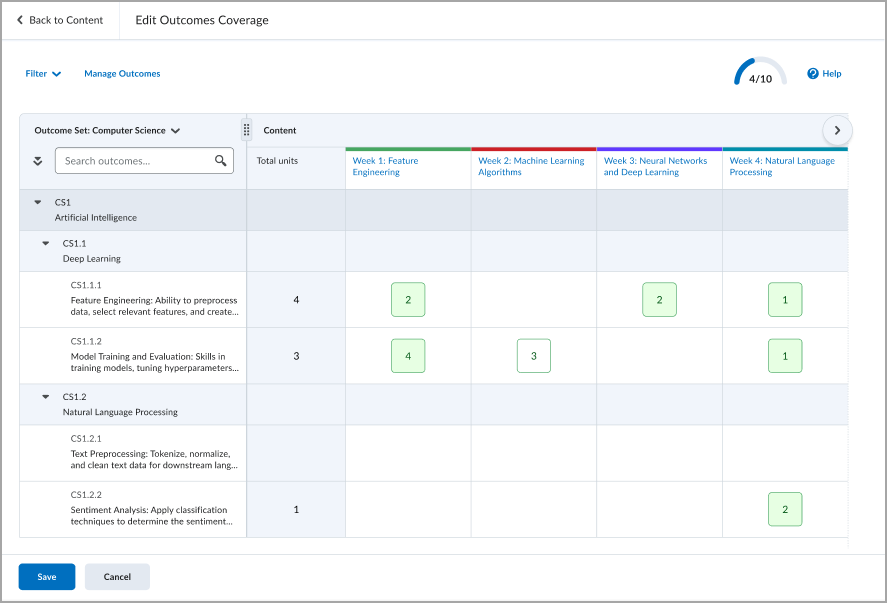
Figure: Use the Edit Outcomes Coverage view to review outcome alignments across course modules, identify coverage gaps, and evaluate overall alignment progress.
Discussions – Anonymous Discussion posts are visible when assessing learners and viewing statistics | New
With this update, instructors with the See Anonymous Post Author permission can view anonymous posts when assessing individual learners in Discussions. Anonymous posts display an Anonymous post label to indicate that the learner posted anonymously.
Previously, instructors with the See Anonymous Post Author permission could reveal a learner's name on an anonymous discussion post, but they could not see anonymous posts when assessing learners or view discussion statistics that included anonymous posts.
 |
Note: When the Allow evaluation of individual posts setting is enabled for a discussion topic, instructors with the See Anonymous Post Author permission can view anonymous posts. However, instructors cannot score these posts individually, and the posts are excluded from individual post calculations.
For topics linked to the grade book, instructors can manually assign an overall grade.
|
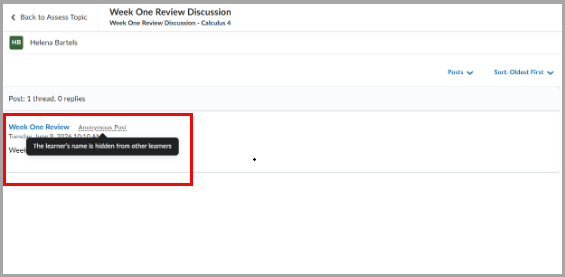
Figure: Instructor view of an anonymous discussion post, showing that the learner’s name is visible to the instructor but hidden from other learners.
Instructors without the See Anonymous Post Author permission continue to be unable to assess anonymous posts.
Discussion statistics now include anonymous post counts for roles with permission to see anonymous post author information. Statistics include counts only for anonymous posts created after this feature is introduced.
When learners view linked discussion activities in Content, the My Work area now includes their anonymous posts. These posts are labeled Anonymous post.
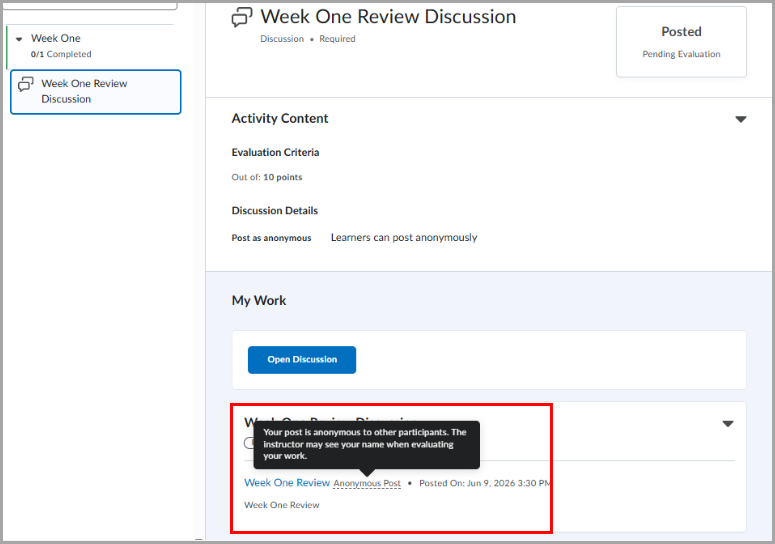
Figure: Learner view of an anonymous discussion post, showing the Anonymous Post label and tooltip explaining how anonymity applies to classmates and instructors.
Groups – New Manage Groups user interface | New
This release introduces a new Manage Groups interface that helps instructors and administrators manage course groups more efficiently. The updated interface supports larger class sizes by making it easier to manage more groups in a single category, reducing the need to spread small-group activities across multiple categories.
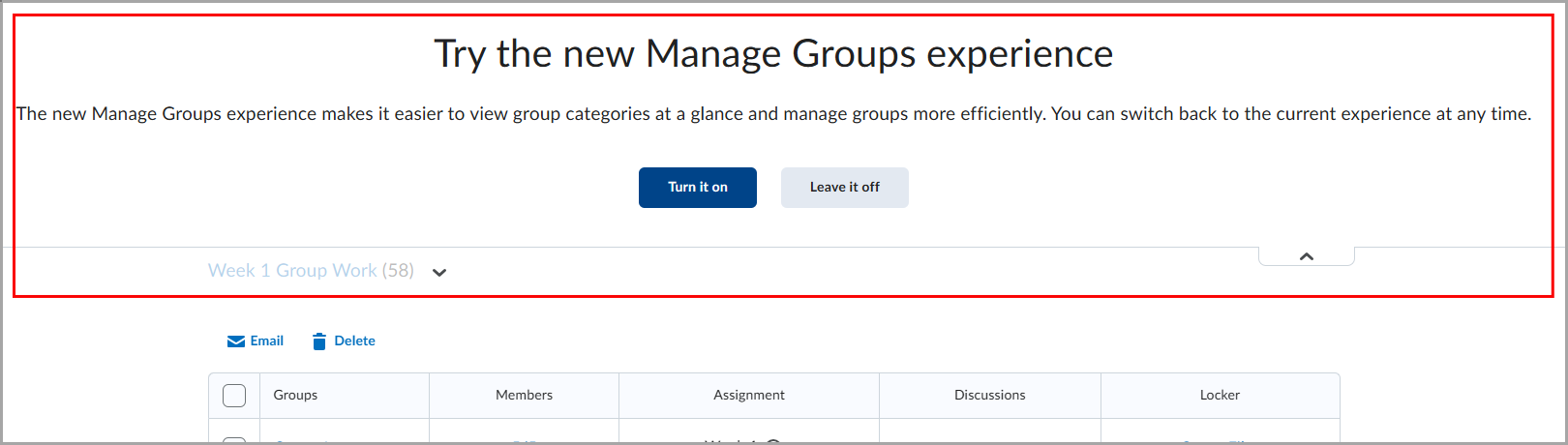
Figure: Choose whether to enable the new Manage Groups experience from the opt-in banner displayed above the current Groups interface.
After instructors opt in, they can view all group categories on a new page. This page helps users quickly validate group setup by showing existing categories and their configurations. Instructors can view each category’s enrollment type, number of groups, and associated activities. Each activity links to its related locker, discussion, or assignment.
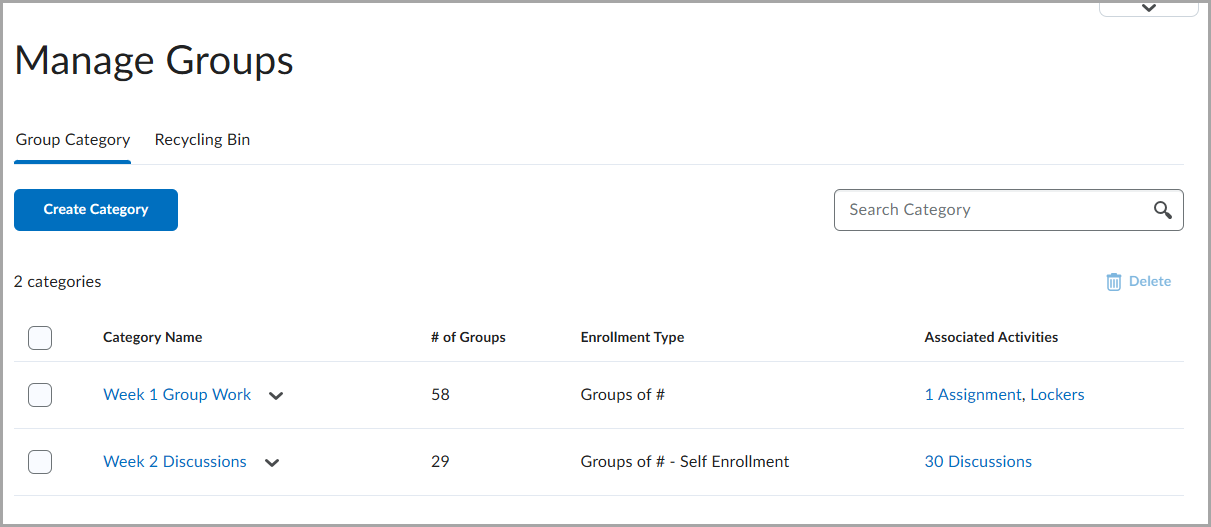
Figure: The new Manage Groups interface displays group categories in a table with the number of groups, enrollment type, and associated activities for each category.
From each category context menu, instructors can edit the category, add a group, manage members, import users, export member details, email the category, or delete the category. Access to the Recycling Bin remains available. However, the Import and Export buttons are no longer on the Manage Groups page; they are now available from each category's context menu.
To view and manage individual groups in a category, instructors can select a category to open a details page. This page shows each group’s name, code, number of members, associated assignments, discussions, and lockers. Instructors can edit each group’s name and code, manage members, export members, email the group, or delete the group.
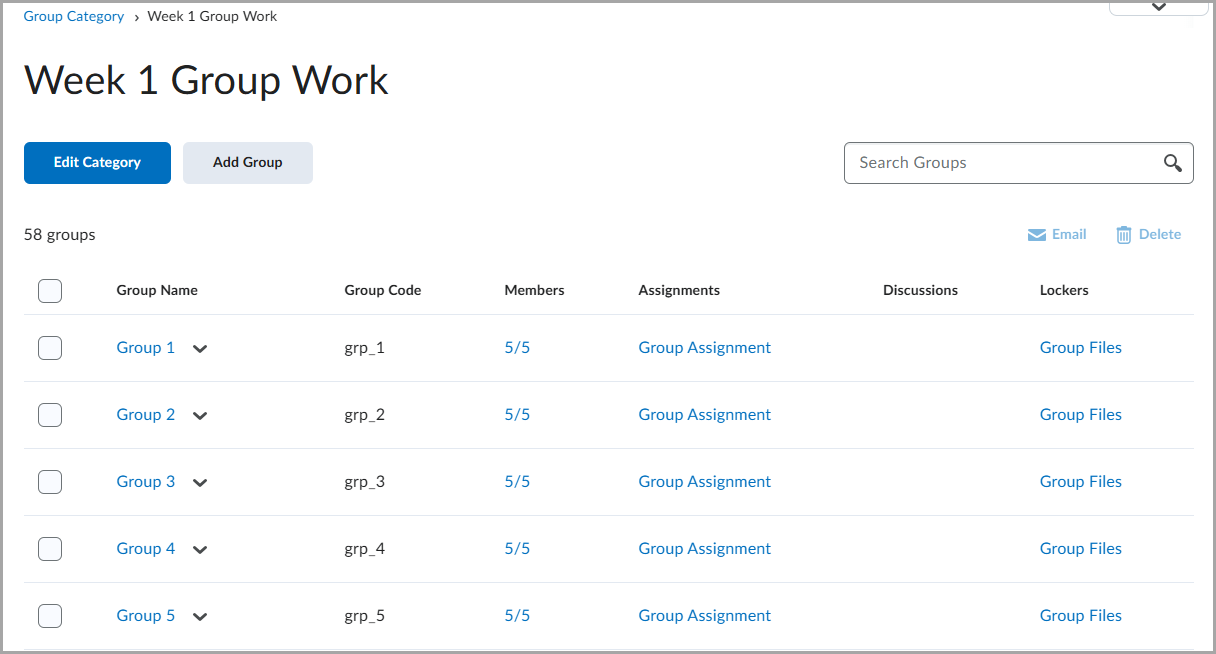
Figure: The group category details page lists individual groups and provides actions to manage the category, add groups, and access each group’s assignment and locker files.
|
Note: In the new Manage Groups experience, the Enroll Users option is renamed to Manage Members. Currently, both terms appear in the Groups tool. Future updates will align this language across the Groups tool pages. |
As part of the improved Manage Groups experience, the Recycling Bin page presents visual updates, including new filtering and search options. These updates do not change how instructors delete or restore groups and categories. 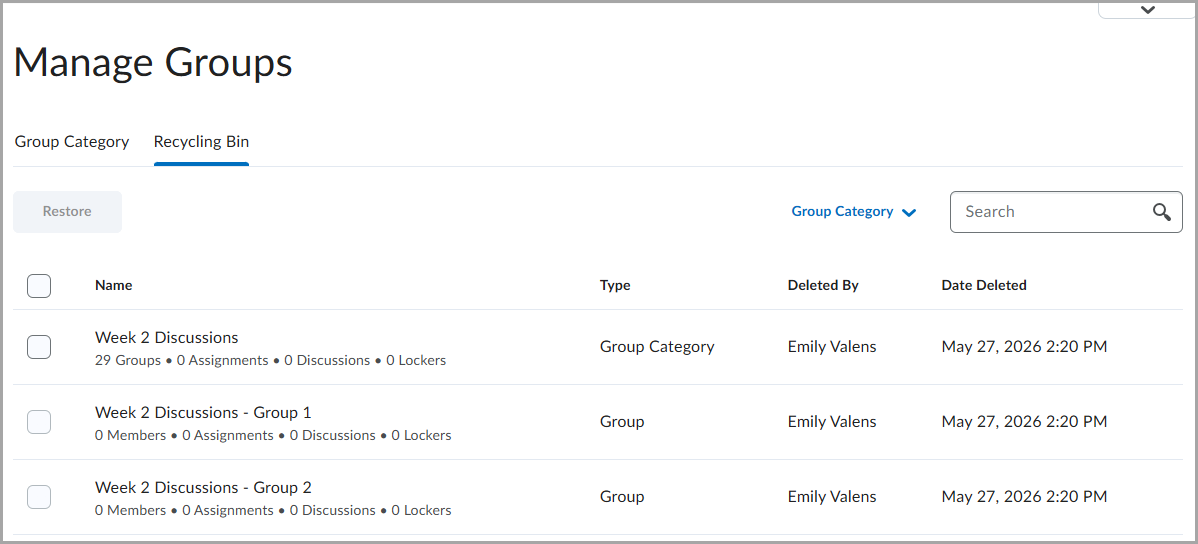
Figure: Recycling Bin lists deleted group categories and groups, with options to search, filter by item type, select items, and restore selected items.
New Content Experience – Immersive View | New
To improve content navigation and course review for learners and instructors, the New Content Experience (NCE) now includes a full-width Table of Contents (TOC) landing page and an immersive view for content items.
Previously, course content and the TOC displayed in a fixed layout. With this release, the full-width TOC becomes the Content landing page, making it easier to review course structure, navigate modules and topics, and resume course progress.
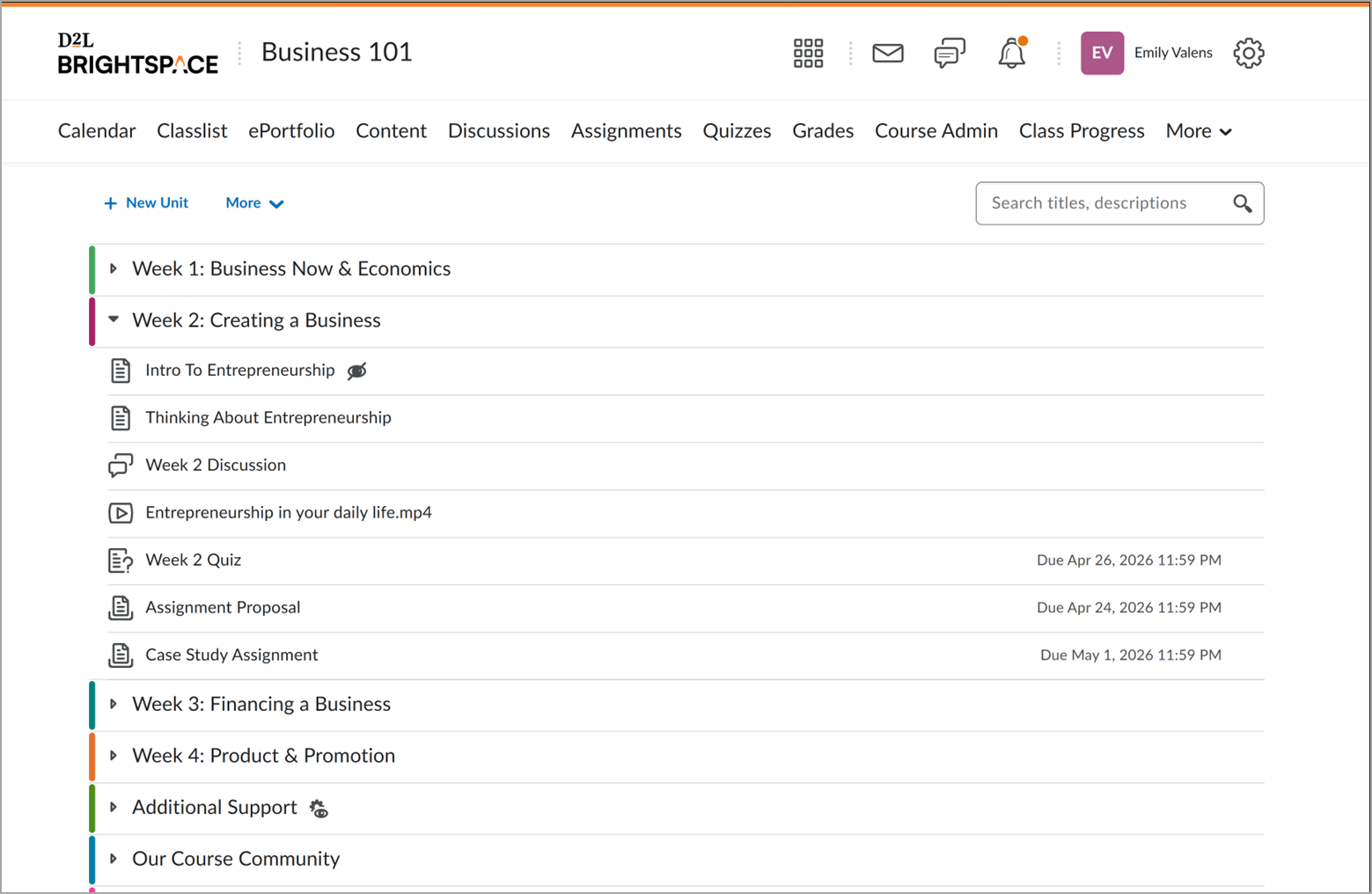
Figure: Review and navigate modules and topics in an immersive, full-screen table of contents view.
When users select a content item from the TOC, Brightspace opens it in an immersive view with a dedicated navigation bar that replaces the standard Brightspace navigation. This experience provides a wider content area with fewer on-screen distractions, helping users focus on course content.
The Immersive View navigation bar includes breadcrumbs that identify the selected content item and its location in the course structure.
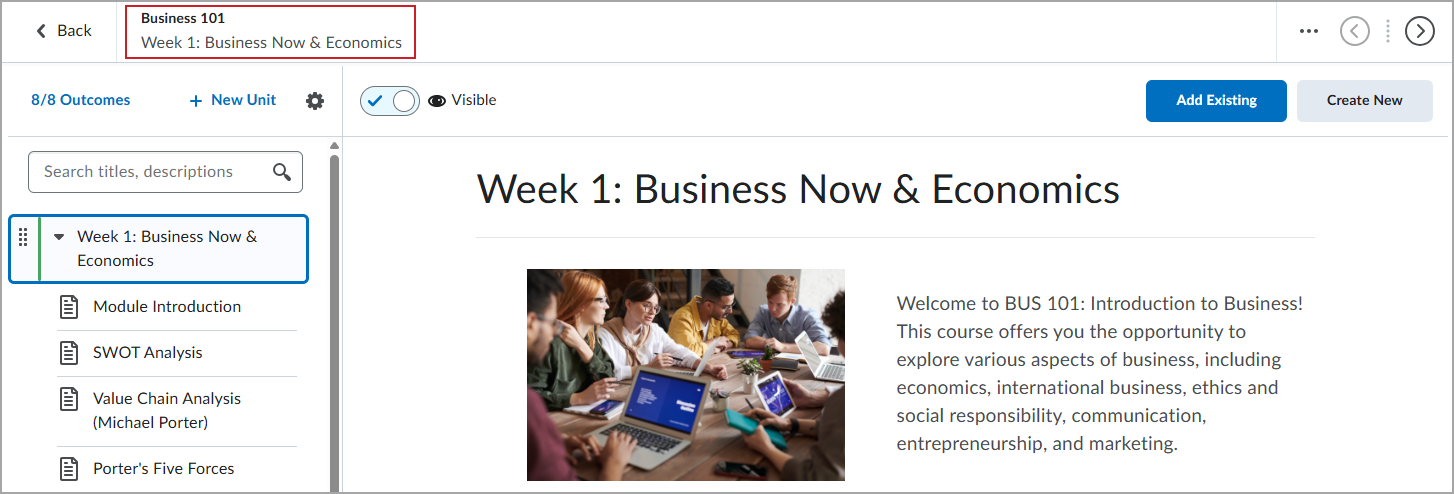
Figure: Use the breadcrumb navigation to identify your current location in the course structure.