D2L makes updates to Brightspace on a monthly basis. Taylor University's updates are usually available the 24th of the month. To access the complete D2L release notes for October 2025, sign into the D2L Brightspace Community and click on this link: October 2025/20.25.10 - Brightspace . Taylor University does not implement all new updates.
Assignments
Assignments — Annotation availability awareness enhancements in assignment creation | New
Annotations are only supported for File and File or Text Assignment Types. They are not supported for Text, Observed, or On Paper Assignment types. In response to requests from instructors for clearer indicators of which types of assignments support Annotations, we’ve enhanced the assignment creation experience with better tool tips, visual cues, and on-screen guidance.
New informational tool tip
To make it easier for instructors to understand what the Annotations tool does and which types of assignments you can use it with, a new informational tool tip now appears beside the existing Annotations check box in the interface for creating assignments.
When you hover over the new information ( ? ) button, a tool tip displays Annotation Tools help.
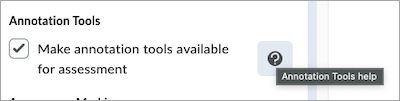
Figure: New Annotation Tools help tool tip.
Clicking the information ( ? ) button opens a pop-up window that explains what the Annotations tool does, and which types of assignments you can use it with. The text in the new window is as follows:
|
Information: Annotation Tools
Use annotation tools to add feedback directly to the uploaded documents by highlighting, drawing, and commenting.
This is available for file submissions only.
|
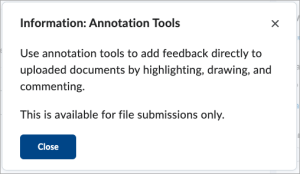
Figure: New Annotation Tools informational pop-up window.
Clear visual indicators make it easy to identify which assignment types support Annotations
To make it easier to immediately understand whether you can use Annotations on an assignment, the Annotations check box now appears disabled (grayed out) for non-file type assignments, such as Text, Observed, or On Paper assignments.
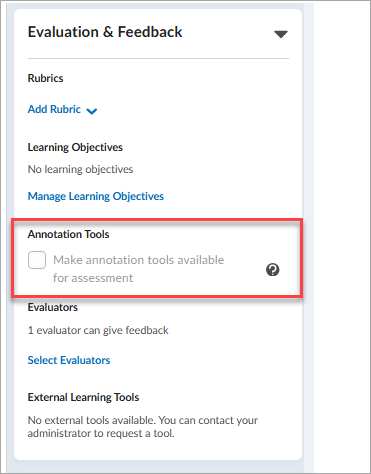
Figure: Visual cues indicate when Annotation Tools are not available for an assignment type.
Updated on-screen guidance
New on-screen guidance indicates when instructors can no longer enable Annotations for an assignment and why.
Guidance for non-file Assignment types
When you cannot enable Annotations for an assignment because the type is Text, On paper, or Observed in person, hovering over the Annotations check box displays the following message:
|
Annotation settings are locked for submissions that are not files.
|
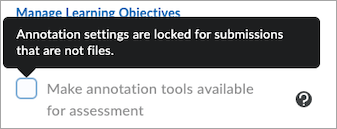
Figure: New on-screen guidance shows when Annotation settings are locked because the assignment type is not File or File or Text.
Guidance displayed for assignments after submissions are received
When you cannot enable Annotations for an assignment because learners already made submissions while the setting was disabled, hovering over the Annotations check box displays the following message:
|
Annotation settings are locked after submissions are received.
|
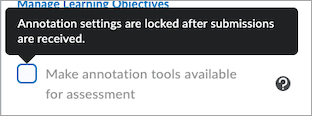
Figure: New on-screen guidance shows when Annotation settings are locked because learners made submissions for the assignment while Annotations were disabled.
Assignments — Improved assignment type selection interface | Updated
A usability improvement makes it easier to select the correct assignment type when you create an assignment.
Previous behavior
Previously, instructors used radio buttons to specify whether an assignment was for a Group or an Individual.
New drop-down menu for selecting Assignment type
A new drop-down menu for selecting the Assignment Type modernizes the interface and lays the groundwork for future enhancements to the Assignments tool.

Figure: New drop-down menu with Individual Assignment Type selected.
Grades
Grades – Comments and Assessments column always visible to learners | Updated
Learners can now always see the Comments and Assessments column in Grades, ensuring that feedback and links to assessments are consistently visible. The column is no longer conditionally displayed, supporting additional links from tools such as Rubrics, Assignments, and Quizzes.
This update supports future enhancements that add information to learner feedback in Grades.
Previously, the column only appeared when a grade item included feedback.
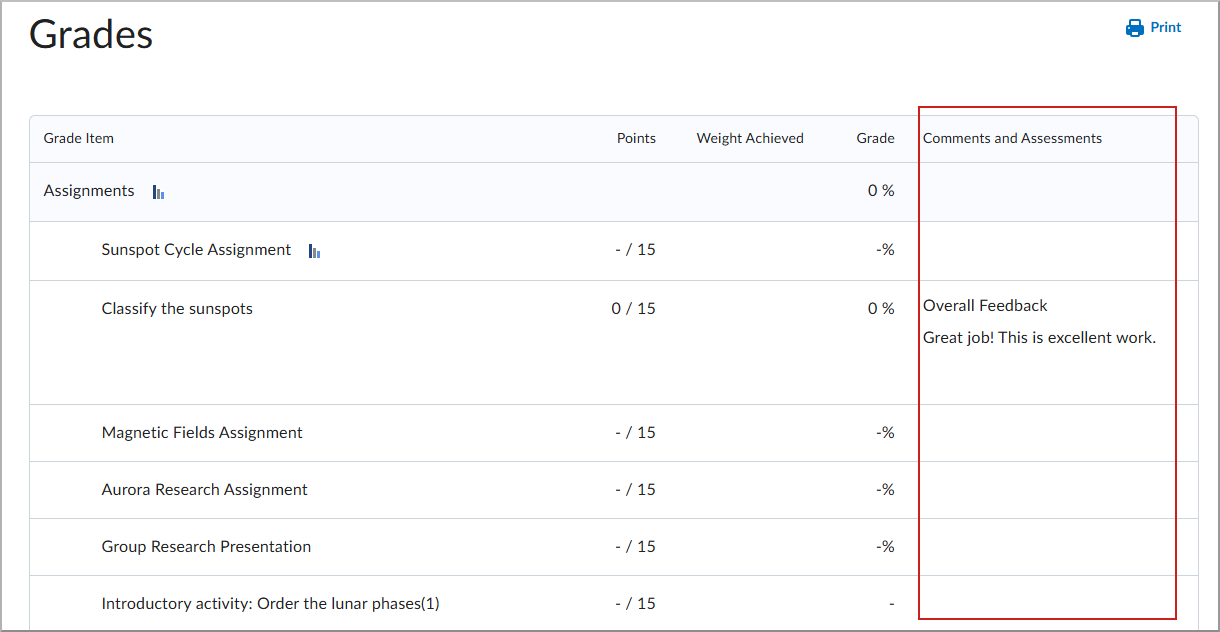
Figure: Comments and Assessments column now appears consistently to learners in Grades.
Groups
Groups – Improvements to Groups APIs ensure consistency with the Groups tool | Updated
This feature aligns the existing Groups API routes with the Groups tool capabilities. Administrators can now perform the following actions using APIs:
- Create, fetch, and update the SelfEnrollmentStartDate for any group category that supports self-enrollment.
- Update the MaxUsersPerGroup for any group category that supports self-enrollment.
- Update the SelfEnrollmentExpiryDate for any group category that supports self-enrollment.
- Fetch and update the AllocateAfterExpiry setting for any group category that supports self-enrollment or auto-enrollment.
- Fetch and update the GroupPrefix for any group category that supports self-enrollment or auto-enrollment.
- Create a group category without setting the EnrollmentQuantity. This parameter is obsolete and is being deprecated with this release.
Previously, the API routes did not allow users to perform all the same actions available in the Groups tool.
Learning Outcomes
Learning Outcomes – Improved display of achievement scales on Evaluation and Feedback pages | Updated
This release enhances the display of achievement scales for Learning Outcomes to improve readability and usability. These changes are applied across evaluation and feedback workflows to ensure a unified presentation for instructors and learners.
In the new layout, the achievement level columns expand when users expand the right panel, displaying more of the level names and allowing users to scan them more easily.
In the previous layout, only the first few characters of the level names were visible for achievement scales with many levels or long level names. Users had to hover over a level to see its full name, which was not intuitive or accessible, especially on mobile devices.
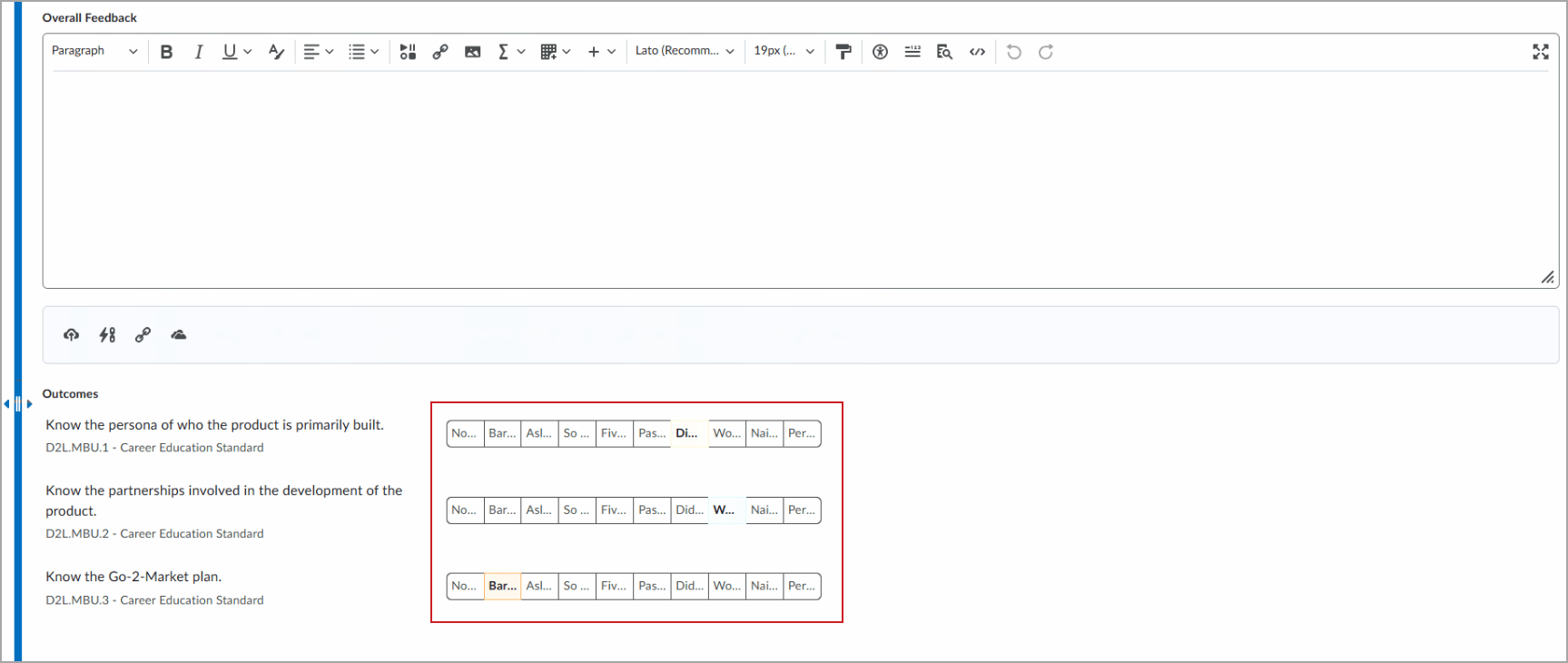
Figure: The Evaluation page before this update.
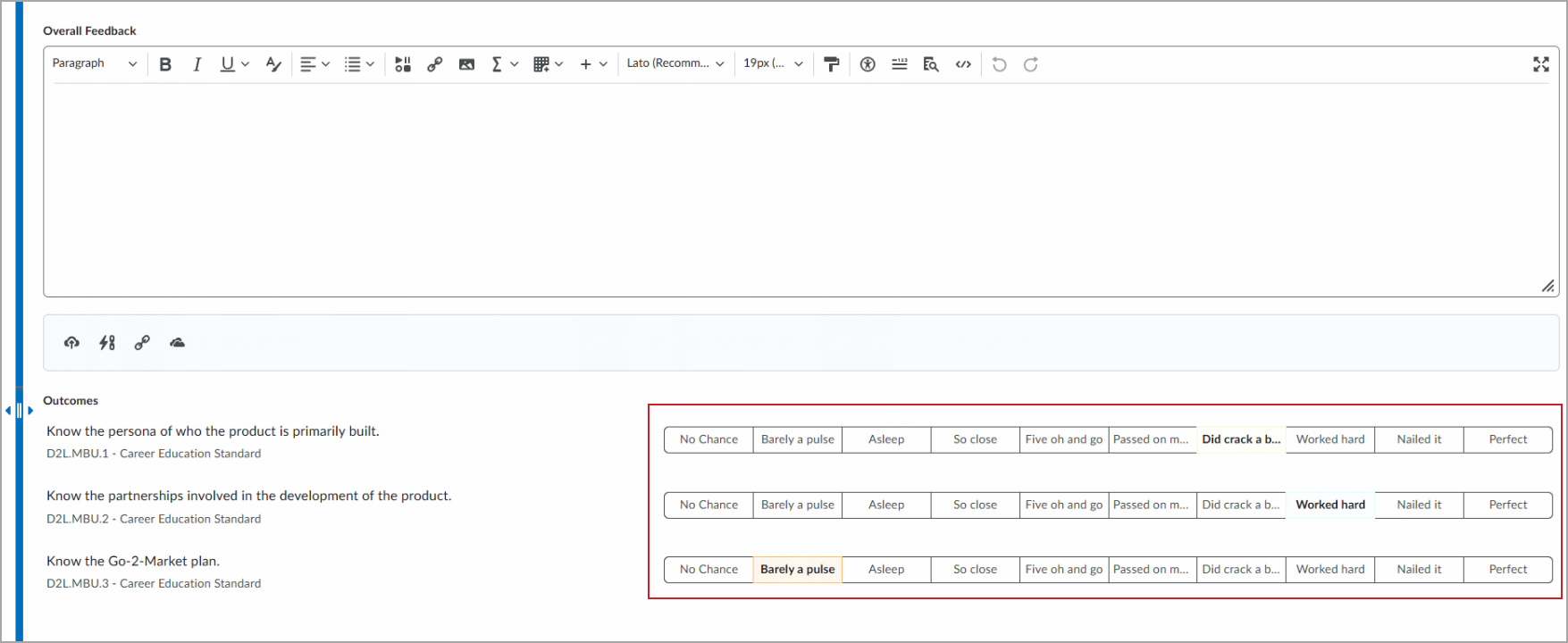
Figure: The Evaluation page after this update.
LTI – Consistency between LTI Advantage deep links and Content Item Links | Updated
The LTI Advantage 1.3 deep links and LTI 1.1 Content Item Links are now consistently identified by the brick symbol across all areas of Brightspace. This update improves the user experience for instructors and administrators by providing a consistent visual indicator for third-party tools.
 |
Important: Custom images for LTI 1.1 links remain unchanged. Only default images have been updated. |
Previously, different areas of Brightspace used inconsistent symbols to represent these LTI links, which could lead to confusion.
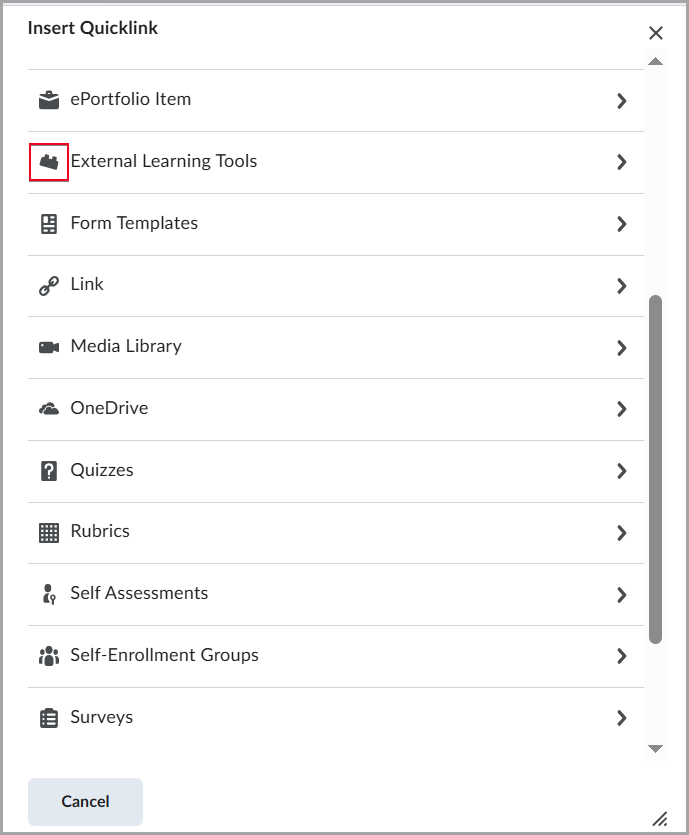
Figure: Example of the brick symbol in Brightspace used to identify External Learning Tools (LTI) links within the platform.
LTI – Third-party processing tools are copied with assignments | New
When assignments that use third-party processing tools are copied within or between courses, the tools are now copied along with the assignments.
The system passes context to the third-party tool about the assignment's original course, ensuring the tool behaves the same way in the destination course.
|
Important: To ensure the tool receives this information, the $Activity.id.history Substitution Parameter must be enabled at registration. Since Substitution parameters cascade from registration to deployment to link, enabling this parameter at registration ensures the information is included in all launches and submission notices. |
This enhancement simplifies the course copy process when using third-party processors by removing the need for manual reconfiguration.
Previously, instructors had to manually reconfigure third-party tools after copying Assignments because the tools were not included in the copy.
Media Library
Media Library – Improved Media Library to help better organize and manage your course assets| Updated
This release introduces several new features to improve the capabilities of the Media Library and allow users to have a wider variety of assets that can be reused in their courses.
These improvements include:
- Add Images, Office Documents, PDFs, and SCORM packages directly to Media Library for re-use across your courses.
- Use Media Library’s new Manage Versions menu to upload and manage a new version of your asset.
- Create folders to better organize your assets by type, subject, or however you’d like.
- Share a folder with another user by adding them to a folder as a collaborator.
 |
Note: It is recommended that adding collaborators should only be used by administrators at this time. |
The following file types can be uploaded to Media Library:
- Video: .mp4, .avi, .f4v, .flv, .m4v, .mov, .webm, .wmv, and the ability to optimize for streaming (2GB max and up to 720p output)
- Audio: .mp3, .m4a, .ogg, .wav, .wma (1GB max)
- Document: .doc, .docx, .odt, .xls, .xlsx, .rtf, .pdf, .ppt, .pptx, .pps, .ppsx, .odp
- Image: .jpg, .jpeg, .png
- Course Package: .zip (SCORM Only)
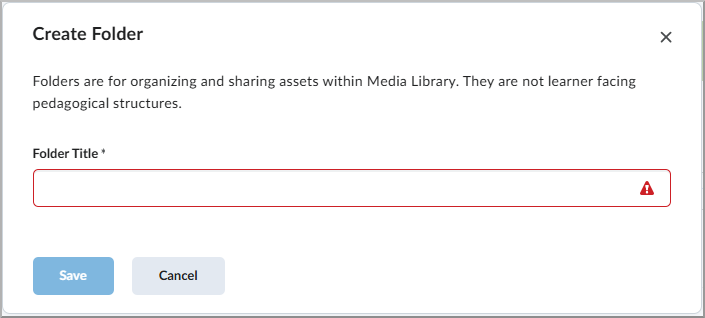
Figure: Create Folder window in Media Library with options to save or cancel.
Quizzes
Quizzes – Attempt exports retain line breaks in question content | Updated
Instructors can now export quiz attempts using the Export to CSV and Export to Excel options without removing line breaks in question text or answers.
Previously, line breaks in question text and answers were removed during export.
Quizzes – Hide Quiz Question Points | Updated
Instructors can now hide the point value for quiz questions to ensure learners focus on all questions equally, without the risk of inferring the number of correct answers based on point value. This feature is particularly useful in scenarios like employee training and association quizzes.
The new feature helps with the following:
- Avoiding Hints in Multi-Select and Written Response Questions. Hiding point values prevents learners from guessing the number of expected answers based on the score, promoting a more consistent effort across all question types.
- Diagnostic Assessments. This option is beneficial for assessments like subject knowledge audits or start-of-term baseline knowledge checks, where the purpose is to gauge understanding rather than focus on scoring.
- Encouraging Equal Effort Across Questions. By hiding point values, learners are less likely to prioritize certain questions over others based on points. Hiding point values ensures a balanced effort and enables the inclusion of control or bonus questions without indicating their significance.
A new option is available within the Timing & Display section when creating or editing a quiz.
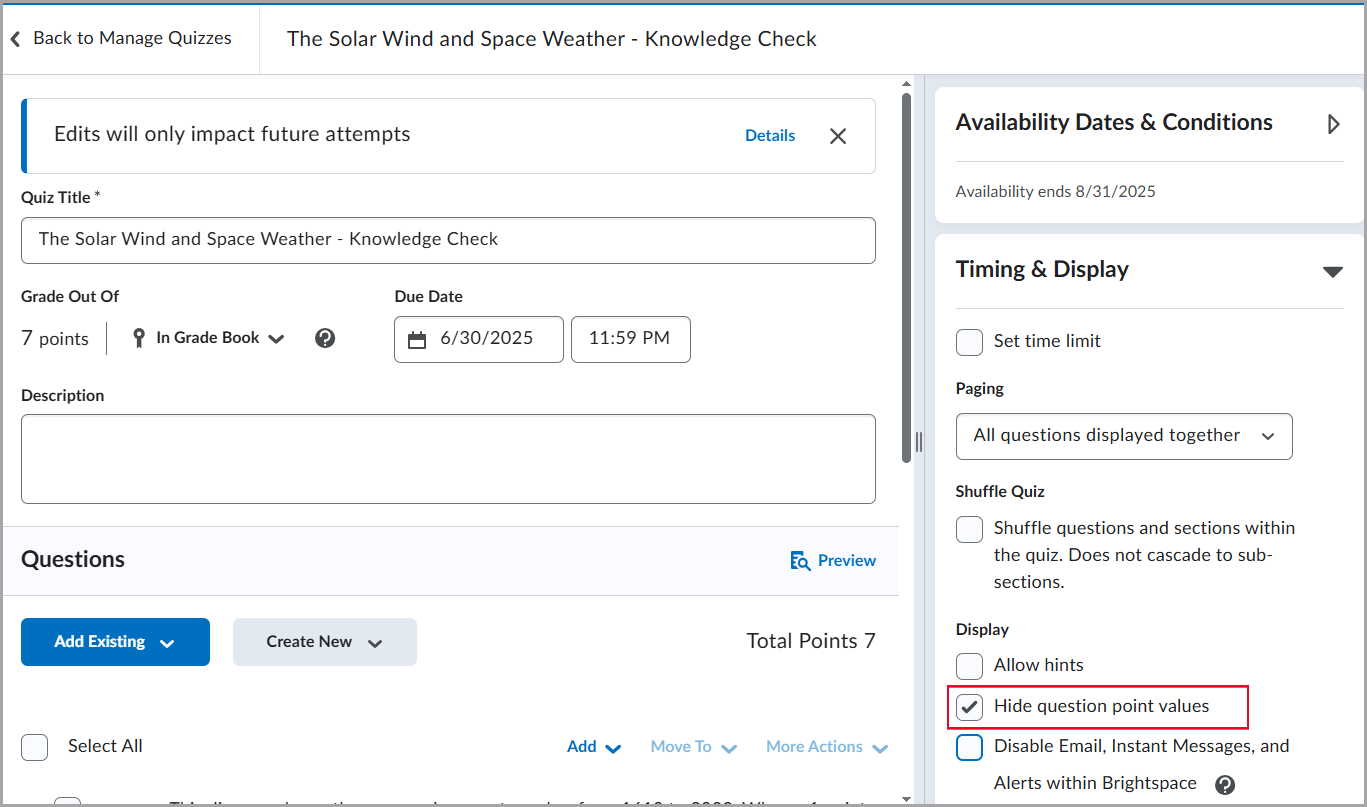
Figure: From the Edit Quiz page, under Timing & Display, select Hide question point values to prevent learners from seeing individual question scores.
Quizzes – Improved visibility for insufficient question pools | Updated
With this release, instructors can now see a status indicator when a question pool has insufficient questions, allowing them to resolve the issue before learners begin a quiz attempt.
If a quiz attempts to draw more questions than are available in a question pool (for example, 12 questions requested but only 10 available), the interface now displays a warning indicator.
This update adds visual warnings in the following areas:
- The Grading view: If learners have already completed a quiz containing an affected pool, messaging displays in the grading evaluation experience.
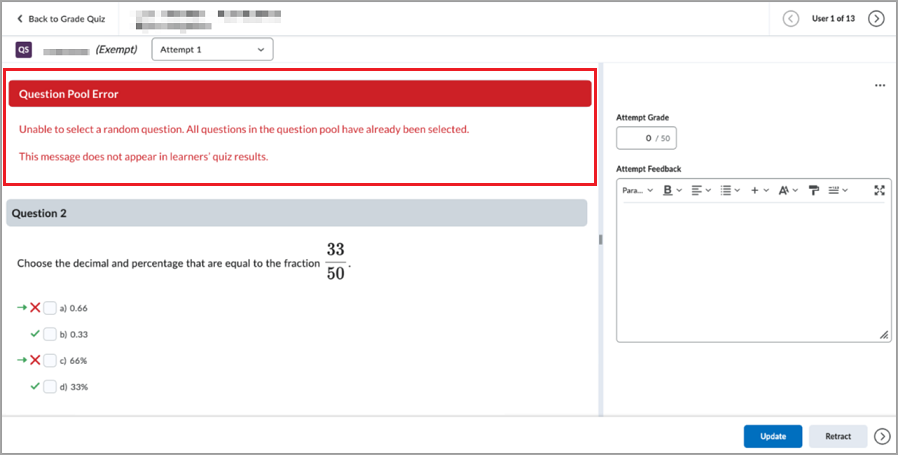
Figure: When grading a quiz, an error message appears indicating the question pool is exhausted.
- The Manage Quizzes page: A status indicator flags quizzes with insufficient question pools.
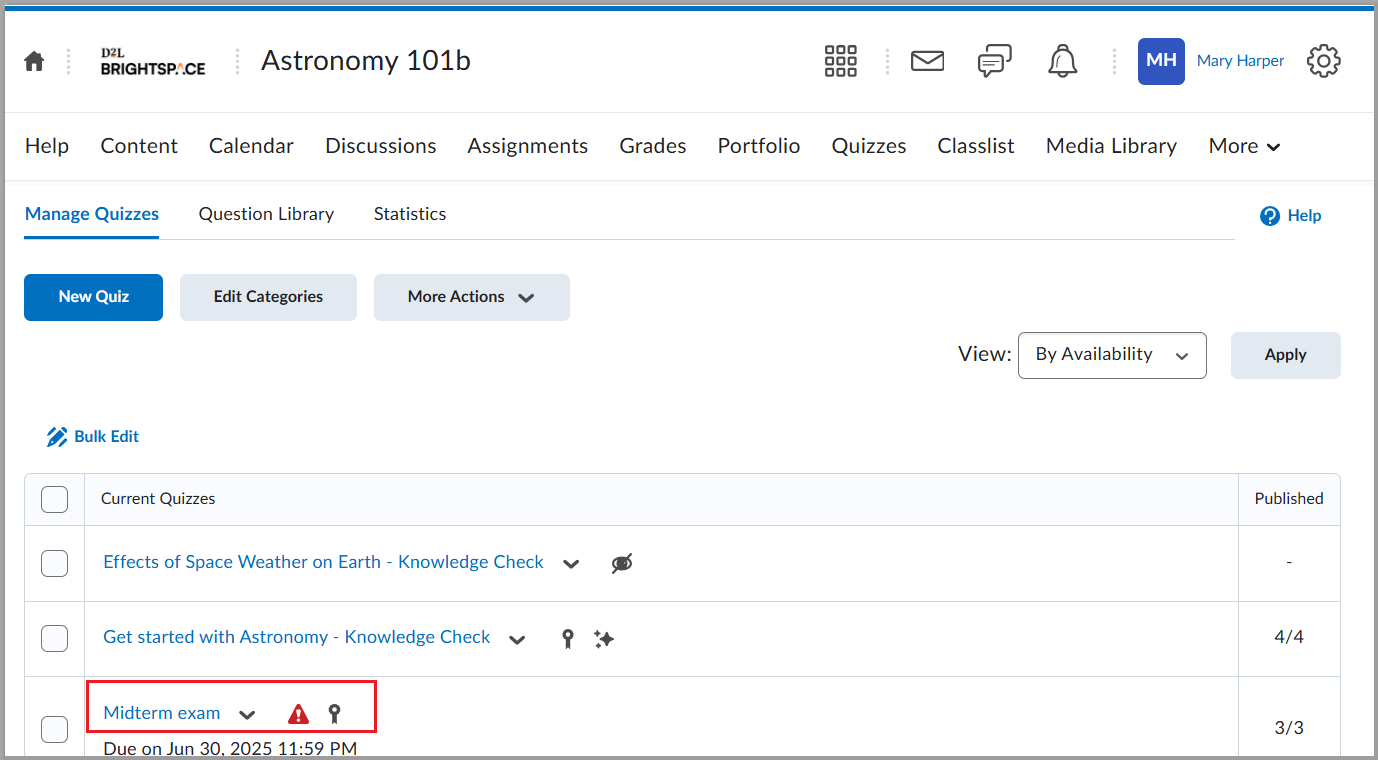
- Figure: In the Manage Quizzes tab, a red warning icon appears beside a quiz name. Instructors can review quiz settings to resolve the issue.
- The Edit Quiz page (Quiz Builder): A warning icon appears directly on the affected question pool.
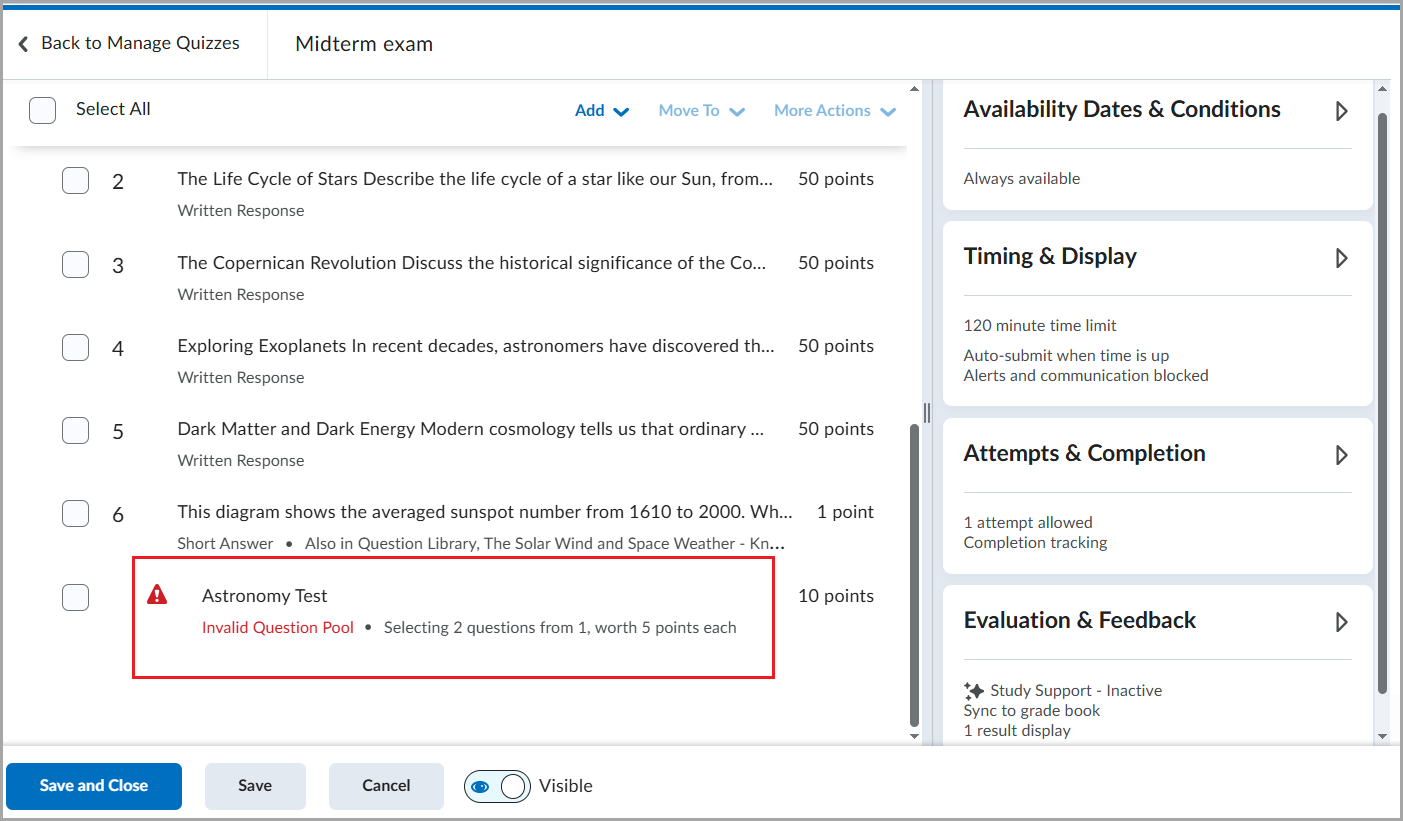
Figure: The Edit Quiz page displays a Question Pool with an error state, labeled Invalid Question Pool.
- The Course Import and Course Copy workflows: Validation now prevents importing or copying pools with an insufficient number of questions.
Previously, no visual indicators identified when question pools contained too few questions, and these could be imported or copied without warning.
User Experience
Brightspace – Improved keyboard accessibility for tab navigation | Updated
To improve accessibility and consistent experiences for users navigating Brightspace with a keyboard, the tab groups on some pages have been updated. When navigating with a keyboard, pressing Space or Enter on the keyboard now selects a focused tab. Previously, tabs auto-selected when navigated to via keyboard.
The following pages contain tabs that are affected by this update:
- Additional Details tabs in the Content tool
- Attempt Log tabs in the Quizzes tool
- All tabs in the Terms and Conditions tool
To navigate among tabs in Brightspace:
- Press Tab or arrow keys to move focus between tabs.
- Press Space or Enter on the keyboard to activate the focused tab.
|
Note: This update does not affect interactions with tabs when using a mouse or touchscreen. |
This change is based on guidance from W3 best practices. To learn more, refer to the ARIA Authoring Practices Guide Tabs Pattern page for more information.
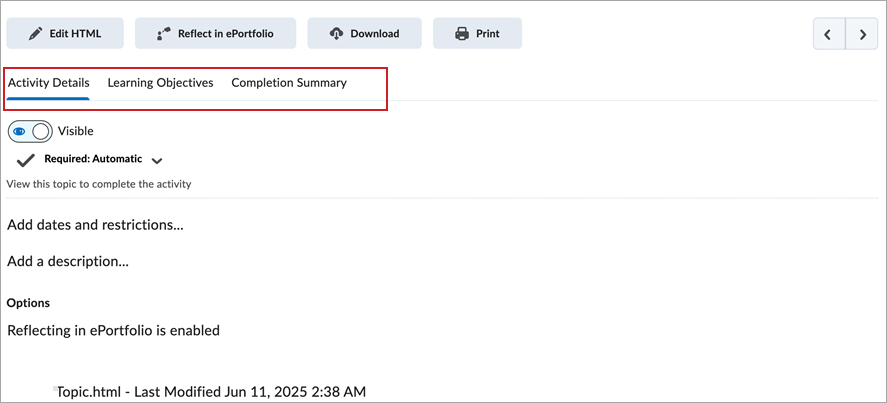
Figure: Navigate the Activity Details, Learning Objectives and Completion Summary tabs in Content by keyboard using the Tab key then pressing Space or Enter.
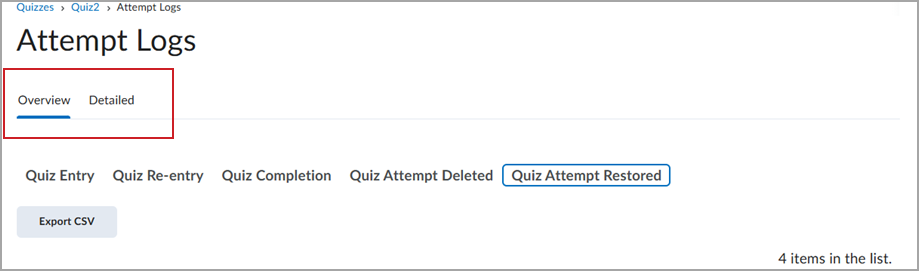
Figure: Navigate the tabs in Quizzes > Attempt Logs by keyboard using the Tab key then pressing Space or Enter.
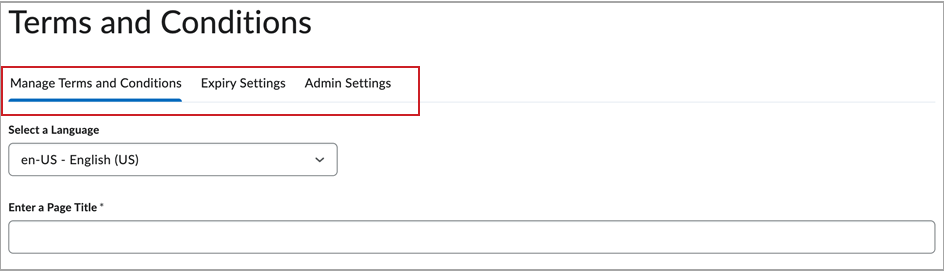
Figure: Navigate the tabs in Terms and Conditions by keyboard using the Tab key then pressing Space or Enter.
Brightspace – Tooltip text repositioning | Updated
To improve the visual experience across Brightspace, new positioning logic is applied to tooltip text that ensures the text wraps in the text box and remains visible on the screen. This update is a visual update only; there are no changes to the tooltip text. The majority of tooltips in Brightspace are not changed by this update.
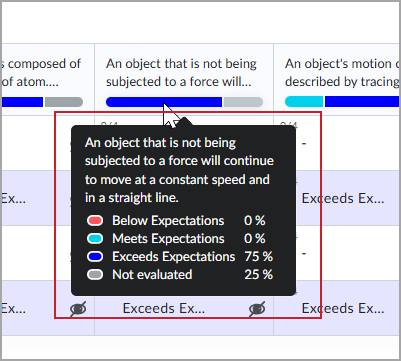
Figure: A tooltip with updated positioning logic displays the tooltip text in a clearly visible text box with improved text wrapping.